
The Luster Diminished
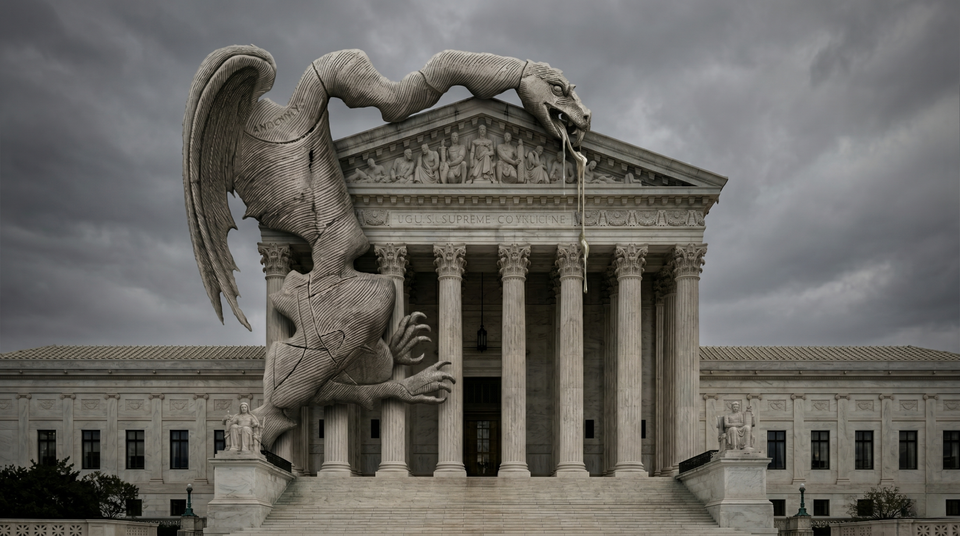
"As I've said before, the right to vote is the crown jewel of American liberties, and we will not see its luster diminished." - Ronald Reagan, June 29, 1982
Alex: Why do voting districts look like that? Some of them are just… tentacles.
Jordan: Someone drew them that way on purpose.
Alex: I figured. But why do they look so deranged?
Jordan: Because they're not following geography. They're following voters. There was a governor of Massachusetts in 1812 who signed a bill that did exactly that. His party redrew the districts to pack their opponents into as few seats as possible.
Alex: Sounds normal for politics.
Jordan: A painter saw the new map of Essex County on a wall, added a head and wings to it, said it looked like a salamander. The Boston Gazette ran the cartoon. The governor's name was Gerry.
Alex: Gerry plus salamander.
Jordan: Gerrymander. The word is two hundred years old and we're still using it because the practice never stopped.
Alex: What happened to Gerry?
Jordan: He'd called the bill "highly disagreeable" and signed it anyway. Lost his reelection. His party kept the legislature. His name stayed on the salamander.
Alex: Rough trade.
Jordan: The move has two flavors now. You can pack your opponents — cram them all into one district so their votes pile up uselessly. Or you can crack them — split their community across several districts so they never hit a majority in any of them.
Alex: And both parties do this.
Jordan: They do. But for sixty years there was a guardrail along racial lines. The Voting Rights Act of 1965.
Alex: That's the John Lewis one. Selma.
Jordan: That's the one. The Act passed because Black voters in the South were being systematically locked out — not by one bad map, by every map. The whole architecture was rigged. So Section 2 of the Act let you challenge a map by showing the outcome: minority group is large enough, lives close enough together, and white voters reliably vote against their candidates. If those things were true and the map diluted minority voting power, the map was illegal.
Alex: Outcomes. Not motives.
Jordan: Right. Because nobody was going to admit the motive. The fix had to match the size of the problem, which was structural.
Alex: Okay, so there's a check.
Jordan: There was. On April 29, 2026, the Supreme Court decided Louisiana v. Callais. Louisiana had been ordered to draw a second majority-Black congressional district. They did. A group of voters who described themselves as "non-African American" sued, said the district was itself an unconstitutional racial gerrymander.
Alex: And the Court agreed.
Jordan: Six to three. And rewrote the rules for everyone else along the way. Before, you proved the outcome. Now you have to prove the state intentionally discriminated.
Alex: Like, prove it on purpose.
Jordan: A "strong inference" of "present-day intentional racial discrimination." Justice Alito's words.
Alex: Okay but — how do you ever prove that? Nobody writes "we drew this to suppress Black voters" in the bill.
Jordan: They don't. And the state gets to offer a different reason. The new ruling specifically says partisan motivation is a valid defense. So a state can say: we didn't draw this against Black voters, we drew it against Democrats.
Alex: Wait. In the South, those are basically —
Jordan: The same people. Yes. Black voters in Louisiana go about ninety percent Democratic. So a state can dilute Black voting power and call it partisan strategy and the dilution is now legal.
Alex: That's the loophole.
Jordan: Congress has actually had this exact fight before. In 1980, the Supreme Court ruled in Mobile v. Bolden that Section 2 only banned intentional discrimination — almost the same standard the Court just resurrected. The decision triggered nationwide outrage. Civil rights cases collapsed overnight.
Alex: What did Congress do?
Jordan: Overrode them. In 1982, Congress amended Section 2 to make the results test explicit. The Senate passed it 85 to 8. The House passed it 389 to 24. Reagan signed it.
Alex: Reagan?
Jordan: Reagan. He called the right to vote "the crown jewel of American liberties." That's how bipartisan it was. Everyone agreed an intent standard was unenforceable, and unenforceable meant minority voters had no protection.
Alex: And forty-four years later —
Jordan: Six political appointees put the intent standard back. Justice Kagan wrote that voters challenging a discriminatory map will now find it "nearly impossible" to win their cases. She called Section 2 "all but a dead letter."
Alex: Rest in power, Section 2.
Jordan: One hour after the decision came down, the Florida House approved a new congressional map. Four more Republican seats.
Alex: One hour.
Jordan: Locked and loaded. The map was already written. The governor had been talking publicly for months about how the upcoming Supreme Court ruling would clear the way. House Democrats asked for a two-hour recess to read the decision. The Republican majority voted it down. The map drawer admitted under oath he'd used partisan data on every district.
Alex: They didn't even pretend to read it.
Jordan: DeSantis posted on social media: Called this months ago.
Alex: Okay but — Virginia drew new maps. California drew new maps. Both sides are doing this right now.
Jordan: They are. But one side just lost the legal tool that existed to protect minority voters from being drawn into irrelevance. The other side had a map in the drawer waiting for the ruling to make it legal.
Alex: ...
Jordan: The Voting Rights Act wasn't a procedural nicety. It was a structural fix for a structural problem. Black voters were being systematically denied representation, and Section 2 was how you proved it without having to read a legislator's mind.
Alex: So now the only people who can be stopped from gerrymandering are the ones dumb enough to say the quiet part out loud.
Jordan: And almost nobody is that dumb.
Alex: ...You know what gets me? In 1812, the Boston Gazette ran one cartoon and the public lost their minds. People hated this on sight. The word became a slur in a week.
Jordan: It's been a slur ever since.
Alex: Two hundred years of everyone agreeing this is bad. And Gerry's salamander now has more legal protection from being redrawn than Black voters in Louisiana do.
Jordan: The salamander never had a problem with the courts. It just had a problem with the public.
Alex: ...
Jordan: And the public lost.
Further Reading:
- Louisiana v. Callais, decided April 29, 2026 — SCOTUSblog case page
- Justice Kagan's dissent: "Today's decision renders Section 2 all but a dead letter"
- Florida House passes new map one hour after ruling
- Mobile v. Bolden (1980) and the 1982 VRA Amendments — Wikipedia: Amendments to the Voting Rights Act
- The original 1812 Gerry-Mander cartoon — Library of Congress
© 2026 All rights reserved. Please do not reproduce, repost, or use without permission.