Do Your Part
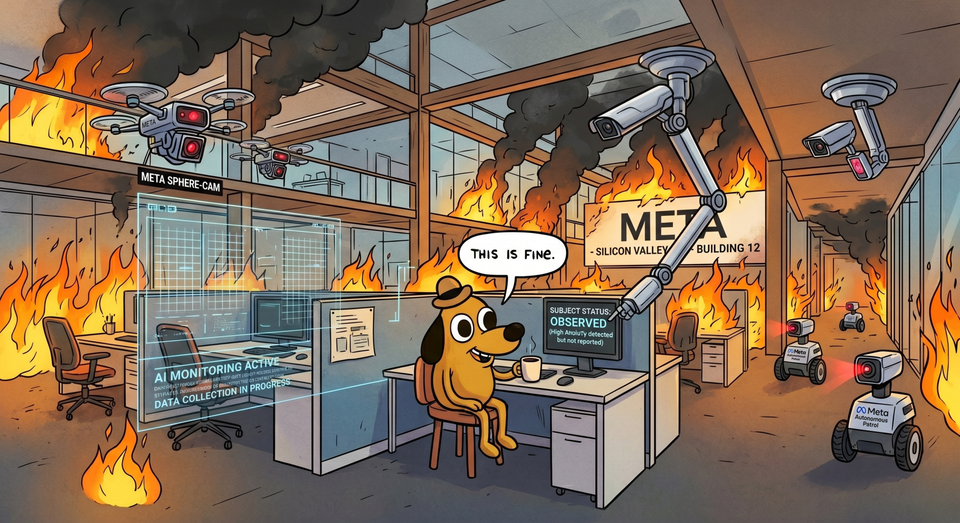
A: Meta is recording everything their employees type. Every keystroke, every mouse movement, with screenshots.
Bx: Yeah. That's how AI works now. You need lots of data.
A: You need lots of data. Yes.
Bx: And workers are cool with this?
A: The memo in Slack told them they could "do their part to help by just doing their daily work."
Bx: That's not really an answer.
A: No.
Bx: But I mean — this is the AI transition. Every industry goes through disruption. The loom, the assembly line —
A: Meta is laying off ten percent of their workforce in May. More cuts planned after that.
Bx: Okay but that's a separate issue.
A: The active surveillance is to build AI that performs white-collar computer tasks autonomously. The layoffs are of the white-collar workers whose inputs are being recorded.
Bx: So the workers are training their... non-replacement?
A: Human resources, for the time being. The corporate organism consumes everything useful before moving on.
Bx: That's a way to put it.
A: Meta spent fourteen billion dollars on a data labeling firm last year. A hundred and forty billion on AI infrastructure this year. They needed training data and already had some sources conveniently on payroll, ready to be cloned and virtualized.
Bx: This is innovation... disruption... Just like the loom put weavers out of work. Brave New World. The scale --
A: The scale is new. The structure has a literature. Nineteenth century Germans, mostly.
Bx: And nobody stopped it then either.
A: They tried, periodically.
Bx: So what do the employees do?
A: The goal, per the memo, is a "closed loop." Agents do the work. Humans direct and review until the agents don't need that either. At which point the loop is closed and the humans are outside it.
Bx: And until then they just —
A: Do their part. By doing their daily work. Yes.
Further reading:
Meta's Model Capability Initiative — Reuters, April 2026
means of production — Wikipedia
© 2026 All rights reserved. Please do not reproduce, repost, or use without permission.